


Budgeting: The Tool That Can Change Your Relationship with Money
August 15, 2026 | by imparsolucoes2002@gmail.com
A practical guide to creating a realistic budget, understanding where your money goes and turning your income into a tool for greater financial control.
Budgeting often gets a bad reputation.
For some people, the word immediately suggests restrictions, giving up things they enjoy and constantly worrying about every pound they spend.
But a good budget isn’t about telling you what you can’t do with your money.
It’s about showing you what you can do.
When you know how much money comes in, where it goes and what you want to achieve, financial decisions become easier. You can spend with greater confidence, prepare for unexpected costs and start directing more of your income towards your future.
A budget is therefore much more than a list of expenses.
It is a plan for how you want your money to support your life.
What Is a Personal Budget?
A personal budget is a plan that compares your expected income with your expected spending over a specific period, usually a month.
At its simplest:
Income − spending = money available for your goals
Your income might include:
- salary;
- self-employed income;
- benefits;
- pension income;
- investment income;
- other regular sources of money.
Your spending can include:
- housing;
- household bills;
- food;
- transport;
- insurance;
- debt repayments;
- subscriptions;
- entertainment;
- savings;
- investments.
The purpose isn’t to predict every penny perfectly.
It’s to create enough visibility to make better decisions.
Why Does Budgeting Matter?
Without a budget, it’s easy to confuse having money available today with being financially secure.
You may receive your salary, pay a few bills, use your card throughout the month and only discover later that very little remains.
A budget changes that process.
Instead of asking:
“How much can I spend?”
you begin asking:
“What should this money do for me?”
That is a significant shift.
A well-designed budget can help you:
- control unnecessary spending;
- prepare for irregular expenses;
- manage debt;
- build an emergency fund;
- save towards specific goals;
- invest regularly;
- identify financial problems earlier;
- make spending decisions with greater confidence.
It can also reduce financial stress because uncertainty is replaced with information.
Step 1: Calculate Your Real Monthly Income
Start with the money you can realistically expect to receive.
If you have a regular salary, this may be relatively straightforward.
If you are self-employed, work freelance or have variable income, budgeting requires a little more care.
Instead of assuming your best month will repeat itself, consider using a conservative estimate based on your recent income.
If your income varies significantly, you may also benefit from creating a separate buffer for months when earnings are lower.
The important point is to budget using realistic income, not optimistic expectations.
Step 2: Identify Your Essential Expenses
Next, determine how much it costs to maintain your basic standard of living.
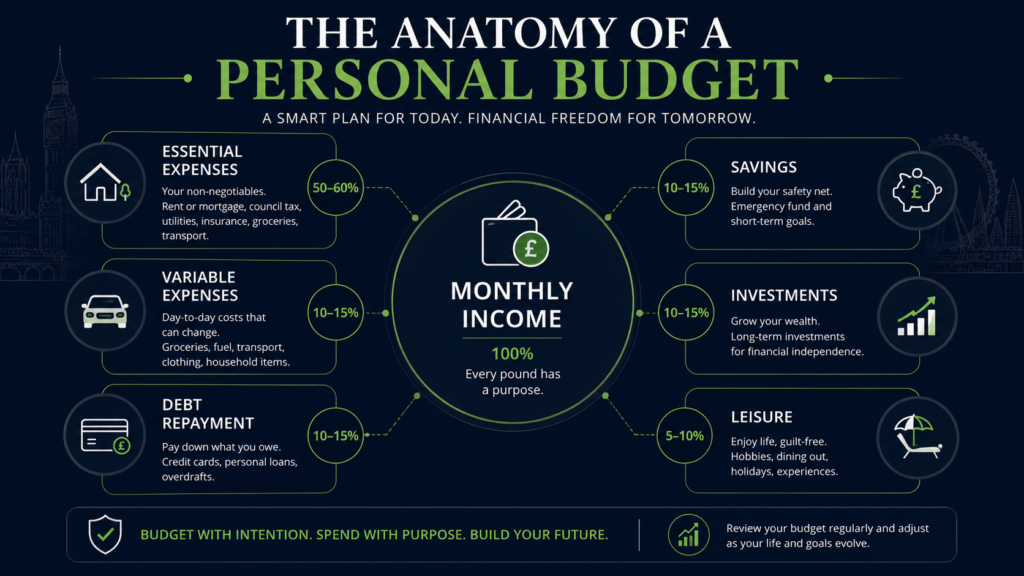
Essential expenses may include:
- rent or mortgage;
- council tax;
- utilities;
- groceries;
- transport;
- insurance;
- essential healthcare;
- childcare;
- minimum debt repayments.
These expenses form the foundation of your budget.
Some are fixed, meaning they tend to remain relatively stable each month.
Others are variable.
For example, your rent may remain the same while your grocery bill changes.
Understanding the difference helps you identify where you have flexibility.
Step 3: Separate Needs from Wants
Not every expense has the same importance.
A useful budgeting exercise is to divide spending into three broad categories:
Needs
Expenses required to maintain your basic lifestyle and responsibilities.
Wants
Expenses that improve your lifestyle but are not essential.
Goals
Money allocated towards future priorities such as savings, debt reduction, investments or major purchases.
This doesn’t mean wants are bad.
A budget that eliminates everything enjoyable is unlikely to be sustainable.
The objective is to ensure that lifestyle spending doesn’t consistently consume money that should be supporting your financial goals.
Step 4: Don’t Forget Irregular Expenses
One of the most common budgeting mistakes is planning only for monthly bills.
Many expenses occur only occasionally:
- car insurance;
- annual subscriptions;
- home maintenance;
- birthdays;
- Christmas;
- holidays;
- school costs;
- vehicle repairs;
- professional fees.
Because these expenses aren’t present every month, they can feel like financial emergencies when they arrive.
They aren’t necessarily emergencies.
They are often simply predictable expenses that weren’t planned for.
If you know that an annual expense will cost £1,200, setting aside £100 each month can make it much easier to manage.
This approach turns irregular costs into predictable monthly commitments.
Step 5: Track Where Your Money Actually Goes
Creating a budget is only half the process.
You also need to compare your plan with reality.
For at least one or two months, track your spending carefully.
Use your bank statements, credit card statements or a budgeting app if helpful.
Don’t rely entirely on memory.
Small purchases can easily disappear from your awareness, particularly when they are paid digitally.
The objective isn’t to judge every purchase.
It’s to discover your actual spending patterns.
You might find that you spend considerably more on eating out than you expected.
Or that several subscriptions you barely use are still being charged every month.
The data gives you something much more valuable than guesswork:
a clear picture of your behaviour.
Step 6: Give Every Pound a Job
Once you understand your income and spending, assign a purpose to your money.
A simple structure might look like this:
Essential costs → financial protection → debt repayment → savings → investments → lifestyle.
The exact proportions will depend on your circumstances.
There is no universal budgeting formula that works for everyone.
Someone with significant debt will have different priorities from someone who has already built substantial savings.
Likewise, a household with children will have different expenses from a single person living alone.
The best budget is therefore not the one that follows a popular rule perfectly.
It’s the one that reflects your actual life and helps you move towards your goals.
Step 7: Build an Emergency Fund into Your Budget
An emergency fund should be treated as a financial priority rather than an afterthought.
Its purpose is to help you deal with unexpected events without immediately relying on expensive credit.
The appropriate amount depends on your circumstances, including your income stability, essential expenses and personal responsibilities.
Rather than becoming discouraged by a large target, start with a manageable amount.
You could begin by building a small cash buffer and gradually increase it.
The key is to make contributions part of your normal budget.
An emergency fund isn’t there to generate the highest possible return.
Its primary purpose is accessibility and financial resilience.
Step 8: Budget for Your Future, Not Just Your Present
A common mistake is creating a budget that accounts for today’s expenses but ignores tomorrow’s goals.
Your budget should include money for the future whenever your circumstances allow.
That might mean:
- building savings;
- contributing to a pension;
- investing;
- saving for a property deposit;
- funding education;
- preparing for retirement;
- creating a business fund.
This is where budgeting becomes closely connected to wealth building.
You are no longer simply asking:
“Can I afford this?”
You are also asking:
“Will this decision help me afford the life I want in the future?”
Step 9: Automate Your Priorities
One of the easiest ways to make a budget more effective is to automate important financial actions.
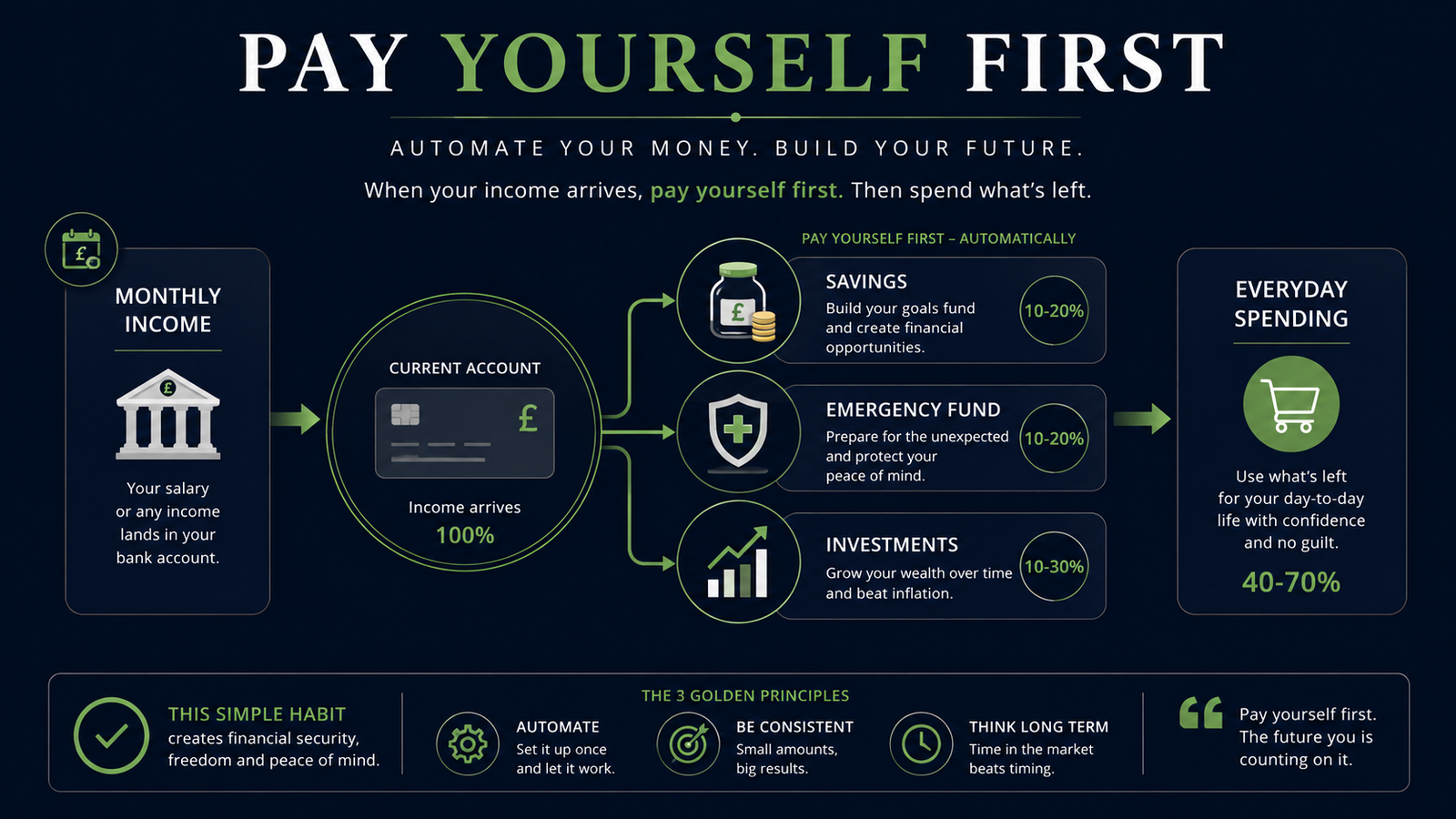
For example, shortly after receiving your income, you could automatically transfer predetermined amounts towards:
- savings;
- an emergency fund;
- investments;
- specific financial goals.
Automation reduces the number of decisions you need to make.
It also helps prevent the common habit of spending first and saving whatever happens to remain.
The principle is simple:
Make the right financial behaviour easier to repeat.
Step 10: Review Your Budget Regularly
A budget is not a document you create once and never touch again.
Your circumstances change.
Your income may increase.
Your rent may change.
A debt may be paid off.
Your family circumstances may change.
Your priorities may evolve.
Review your budget at least monthly and make adjustments when necessary.
A good budget should be flexible enough to adapt without losing its purpose.
Think of it as a financial navigation system.
If your destination changes, your route may need to change too.
What If Your Budget Doesn’t Balance?
This is one of the most important moments in the budgeting process.
If your planned spending is greater than your income, you have a problem that needs attention.
There are usually three broad solutions:
1. Reduce expenses
Identify spending that can be reduced, eliminated or renegotiated.
2. Increase income
Look for ways to improve your earnings through employment, additional work, skills or business opportunities.
3. Do both
Often, the most effective approach is a combination of the two.
Be careful, however, about relying on unrealistic assumptions.
A budget isn’t fixed by writing down income you hope to earn.
It is fixed by creating a realistic plan based on your actual circumstances.
What If You Have Nothing Left to Save?
Don’t assume that a small amount is pointless.
If your budget currently leaves very little room for savings, start with what is realistic.
Even a small recurring contribution can help establish the habit.
Then look for ways to create additional capacity over time.
For example:
£25 a month → £300 a year
£50 a month → £600 a year
£100 a month → £1,200 a year
These amounts don’t include any investment growth, but they illustrate an important principle:
small amounts become meaningful when they are repeated consistently.
The objective is to create a sustainable financial system rather than an unrealistic short-term challenge.
The 50/30/20 Rule: Useful Guide or Oversimplification?
You may have come across the popular 50/30/20 budgeting rule:
- 50% for needs;
- 30% for wants;
- 20% for savings and debt repayment.
It can be a useful starting point for some people.
But it should not be treated as a universal financial law.
Housing costs, income levels, family circumstances and debt obligations vary significantly.
For someone living in an expensive city, essential costs may already exceed 50%.
Someone with substantial debt may need to allocate much more towards repayment.
Someone with a high income and low fixed costs may be able to save considerably more.
Use budgeting frameworks as guidelines, not rigid rules.
A Simple Monthly Budget Example
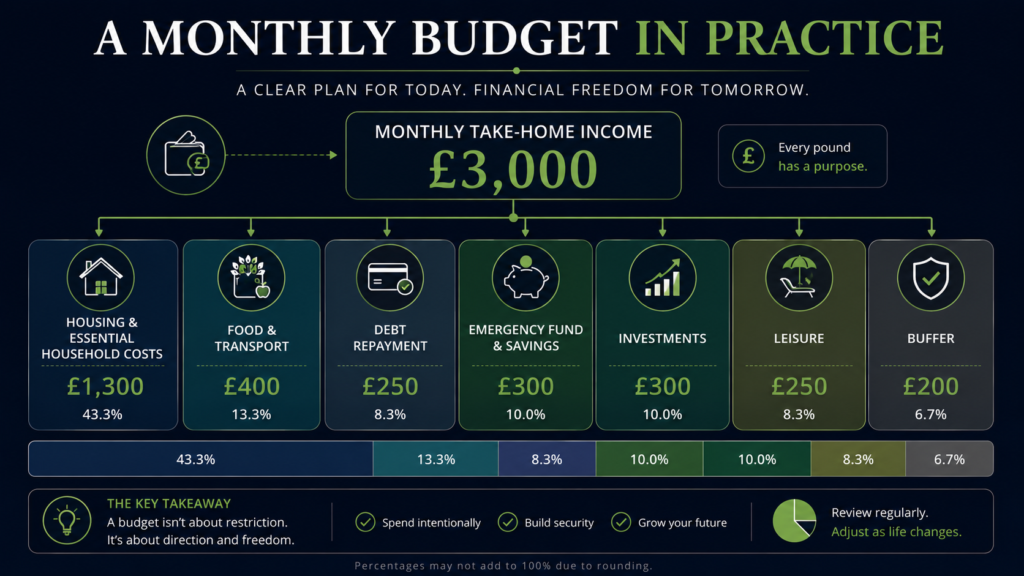
Imagine someone has a monthly take-home income of £3,000.
Their budget might include:
Housing and essential household costs: £1,300
Food and transport: £400
Debt repayment: £250
Emergency fund and savings: £300
Investments: £300
Leisure and discretionary spending: £250
Remaining buffer: £200
The numbers will obviously differ from person to person.
The important point is that the income has been given a purpose before the month unfolds.
That makes financial decisions much easier.
Budgeting Should Give You More Freedom
A good budget isn’t supposed to make you feel trapped.
Quite the opposite.
It can help you spend money on the things you value while reducing spending that doesn’t contribute meaningfully to your life.
Imagine knowing that your essential bills are covered, your emergency fund is growing, your debts are being reduced and your investments are receiving regular contributions.
You can then spend the money allocated to leisure with greater confidence.
That’s very different from spending first and worrying about the consequences later.
A budget creates boundaries so that your money can support your priorities.
Budgeting Is About More Than Cutting Costs
If your only budgeting strategy is to spend less, you may eventually reach a limit.
There are only so many expenses you can eliminate.
That’s why a long-term financial strategy should include both:
better money management + greater earning potential.
Improve your spending decisions.
Reduce unnecessary costs.
Manage debt.
Build savings.
But also invest in your skills, career and ability to generate income.
The combination can create much greater financial progress than either strategy alone.
From Budgeting to Wealth Building
A budget is not the final destination.
It’s the foundation.
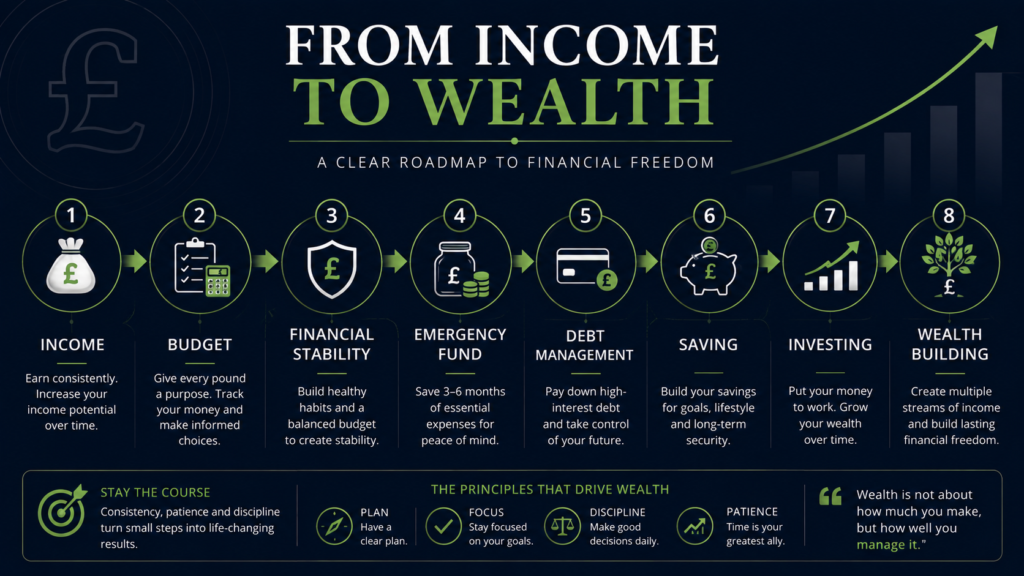
Once your finances become more organised, your money can begin moving through a clear sequence:
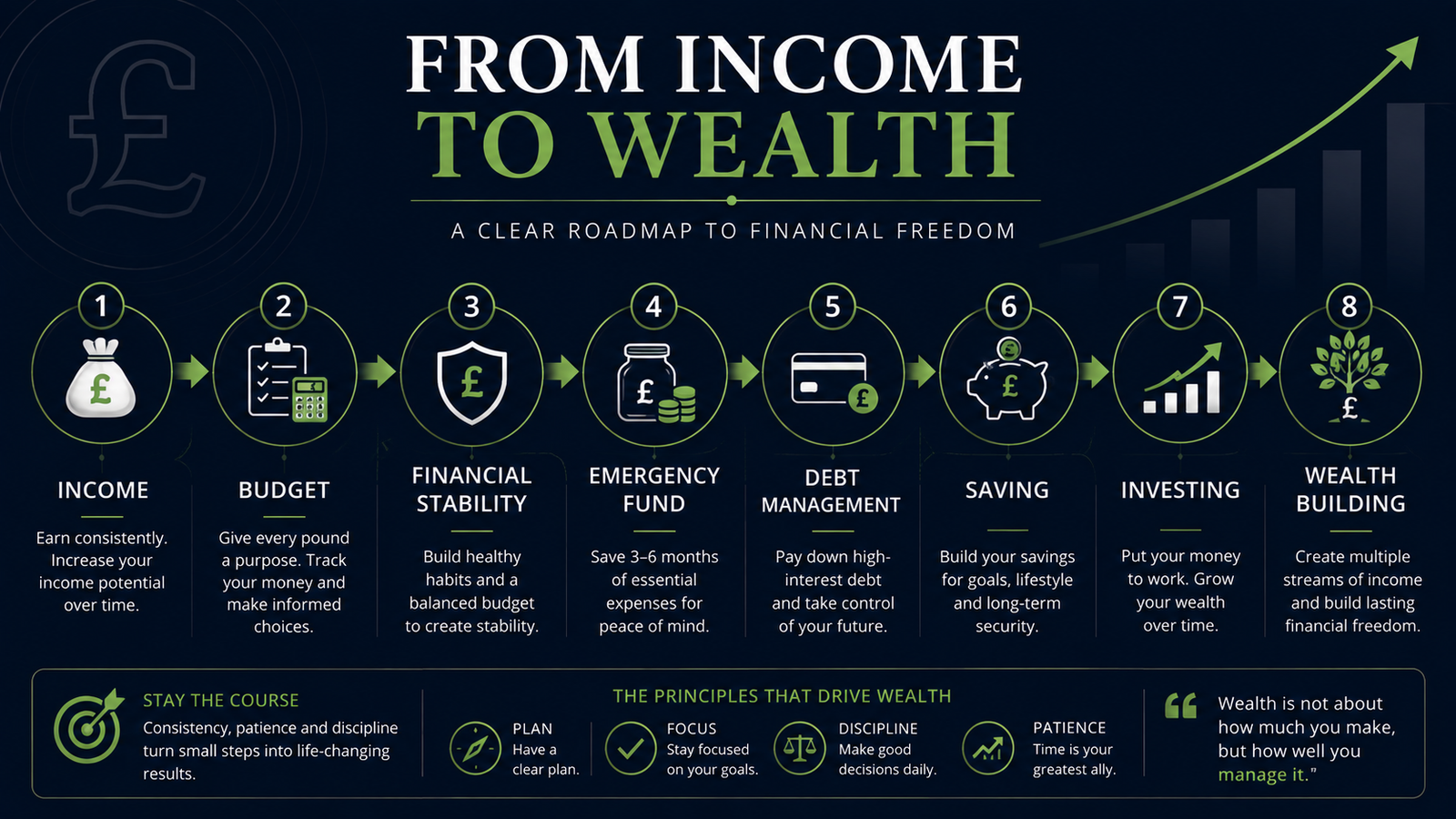
Income → Budget → Financial stability → Emergency fund → Debt management → Saving → Investing → Wealth building
This doesn’t happen overnight.
It is a process.
But the earlier you establish a system that consistently directs part of your income towards your future, the more opportunities you create for long-term financial progress.
Your Budget Should Reflect Your Life
There is no perfect budget.
There is only a budget that is appropriate — or inappropriate — for your current circumstances.
Your financial plan should reflect your:
- income;
- responsibilities;
- lifestyle;
- debts;
- goals;
- risk tolerance;
- priorities.
It should also leave room for life to happen.
Unexpected expenses will occur.
Plans will change.
Some months will be better than others.
Financial organisation isn’t about predicting everything.
It’s about being prepared enough to respond.
Start Your Budget Today
If you don’t currently have a budget, don’t spend weeks trying to build the perfect spreadsheet.
Start with four numbers:
1. How much comes in?
2. How much goes out?
3. What debts do you have?
4. How much can you direct towards your future?
Then improve the picture over time.
Track your spending.
Identify patterns.
Adjust your categories.
Automate your savings.
Review your progress.
The first version of your budget doesn’t need to be perfect.
It simply needs to exist.
Conclusion
A personal budget is one of the simplest tools available for improving your relationship with money.
It gives you visibility over your income and spending, helps you prepare for irregular costs, creates space for savings and investments, and connects today’s decisions with tomorrow’s goals.
Most importantly, budgeting changes the question you ask about money.
Instead of:
“Where did all my money go?”
you can start asking:
“What do I want my money to achieve?”
That is the real power of budgeting.
Your budget isn’t a restriction on your life.
It’s a plan for using your money to build the life you want.
RELATED POSTS
View all

Brazilian Equities: A Guide for UK Investors
August 15, 2026 | by imparsolucoes2002@gmail.com

Brazilian Government Bonds: A Guide for UK Investors
August 15, 2026 | by imparsolucoes2002@gmail.com
Money: How to Get More from What You Already Earn
August 15, 2026 | by imparsolucoes2002@gmail.com