


Brazilian Equities: A Guide for UK Investors
August 15, 2026 | by imparsolucoes2002@gmail.com
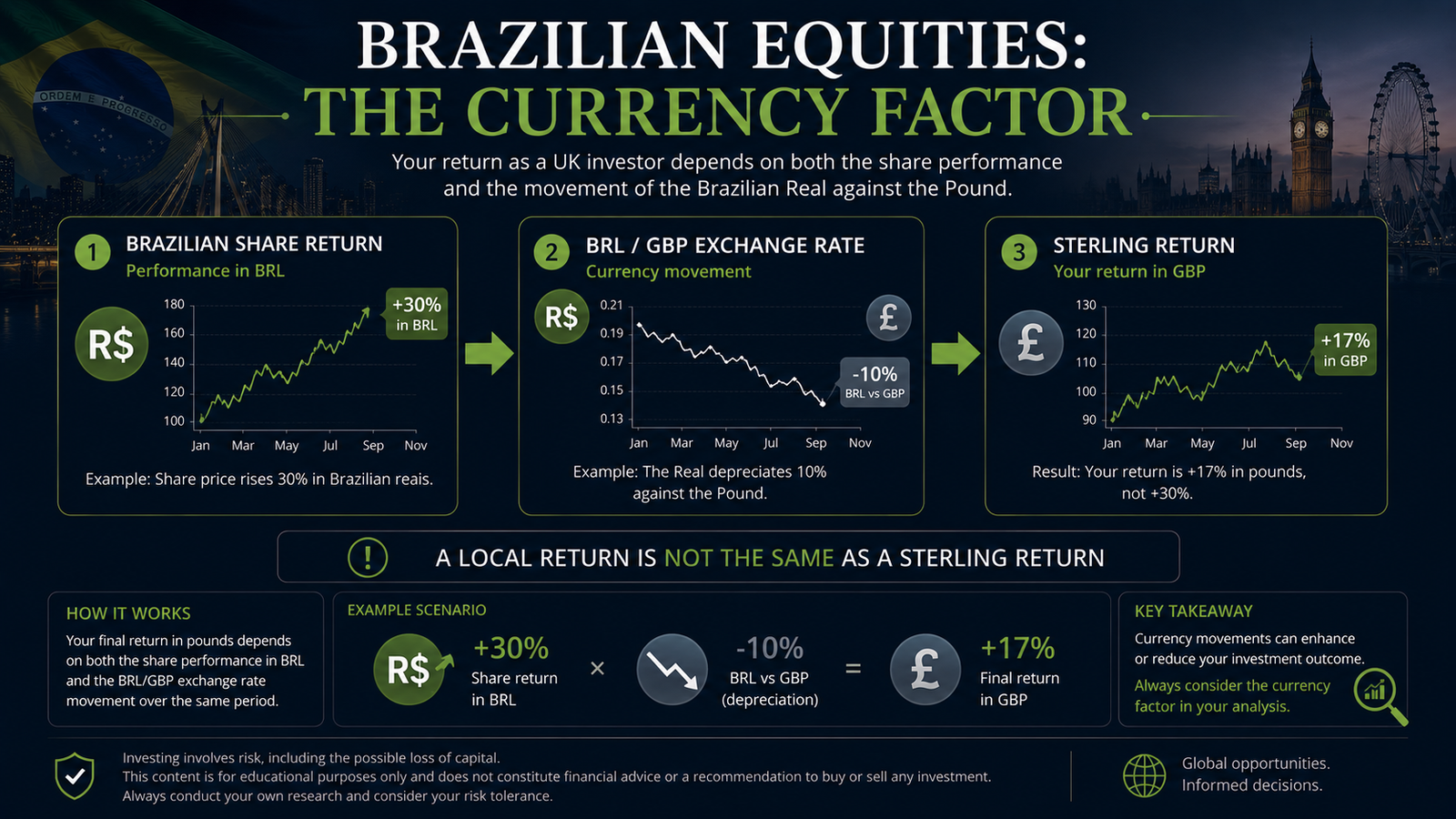

Brazilian shares offer UK investors exposure to one of the world’s largest emerging economies, with significant positions in financial services, commodities, energy, utilities, consumer businesses and infrastructure. But understanding the opportunity requires looking beyond share prices and dividend yields.
When investors in the United Kingdom think about international equities, the United States and other developed markets often dominate the conversation.
Brazil can easily remain outside the radar.
Yet the Brazilian stock market offers something different: exposure to an economy with a large domestic consumer base, globally important commodity industries and a financial system shaped by interest rates that can be very different from those in the UK.
That difference can create opportunities.
It can also create risks.
For a UK investor, therefore, the right question is not:
“Are Brazilian shares better than UK shares?”
It is:
“What could Brazilian equities add to an existing portfolio, and what risks would come with that exposure?”
What Are Brazilian Equities?
Brazilian equities are shares representing ownership in companies connected to Brazil’s listed equity market.
The country’s principal exchange and financial-market infrastructure provider is B3 — Brasil, Bolsa, Balcão.
B3 provides infrastructure for trading equities and other financial instruments and maintains a broad range of market indices.
When you buy shares in a publicly listed company, you become a shareholder.
Your investment can potentially benefit from:
- share-price appreciation;
- dividends;
- other distributions;
- long-term growth in the underlying business.
But the reverse is also true.
The share price can fall, dividends can be reduced or suspended, and the company itself can perform poorly.
Brazilian equities therefore need to be analysed as business investments, not simply as opportunities to benefit from Brazil’s economy.
Why Could Brazilian Equities Interest UK Investors?
Brazil has several characteristics that distinguish its equity market from the UK.
The country has:
- a large domestic market;
- globally significant natural resources;
- major agricultural production;
- substantial energy infrastructure;
- a large banking sector;
- significant mining activity;
- developing infrastructure;
- exposure to emerging-market growth.
This means a Brazilian equity portfolio can contain businesses whose revenues and economic drivers are very different from those of many UK-listed companies.
For an investor already holding UK equities, that can potentially provide geographical and sector diversification.
However, diversification is only valuable when the additional assets introduce genuinely different sources of risk and return.
Understanding the B3
B3 is central to the Brazilian equity market.
It operates trading, clearing, settlement and other market infrastructure and provides indices that allow investors to track different segments of the Brazilian market.
One of the best-known Brazilian equity benchmarks is the Ibovespa.
The Ibovespa is designed to represent the performance of a portfolio of the most relevant and actively traded shares on the Brazilian market.
It is therefore frequently used as a reference point when discussing the performance of Brazilian equities.
But an important distinction should be made:
The Ibovespa is not the entire Brazilian economy.
It represents a particular segment of the listed equity market.
A UK investor should therefore avoid treating the index as a perfect representation of every Brazilian business.
The Main Sectors of the Brazilian Stock Market
One of the most interesting characteristics of Brazilian equities is the composition of the market.
Several sectors have significant representation.
Financial Services
Brazil has a large and sophisticated banking sector.
Major financial institutions provide:
- retail banking;
- corporate lending;
- credit cards;
- insurance;
- investment services;
- digital banking;
- payment solutions.
The sector can be strongly influenced by interest rates, credit conditions and economic growth.

Oil and Energy
Brazil is an important energy producer, including significant offshore oil resources.
Energy companies can therefore provide exposure to:
- oil prices;
- domestic energy demand;
- production growth;
- infrastructure;
- global commodity markets.
But energy investments are highly sensitive to commodity prices and government policy.
Mining
Brazil is a major mining economy and is particularly important in global iron-ore markets.
Mining companies can therefore offer investors exposure to global demand for industrial commodities.
However, this also means their performance can be heavily influenced by factors outside Brazil.
For example, changes in Chinese industrial demand can affect commodity prices and consequently Brazilian mining companies.
Utilities
Electricity and other infrastructure-related businesses are also important within the Brazilian market.
Utilities can sometimes appeal to investors interested in:
- relatively predictable cash flows;
- dividends;
- infrastructure exposure.
But regulation is an important consideration.
Government decisions can influence tariffs, investment requirements and profitability.
Consumer Businesses
Brazil’s large population creates a substantial domestic consumer market.
Listed companies operate in areas such as:
- food and beverages;
- retail;
- consumer products;
- e-commerce;
- healthcare;
- travel;
- entertainment.
These businesses provide exposure to Brazilian household consumption and economic growth.
Industrial and Infrastructure Companies
Brazil’s scale and infrastructure requirements create opportunities for businesses involved in:
- construction;
- logistics;
- transportation;
- industrial production;
- engineering;
- infrastructure services.
These companies can benefit from economic development and investment cycles, but they may also be highly sensitive to interest rates and government spending.
The Commodity Connection
Perhaps the most distinctive feature of Brazilian equities is the country’s connection to commodities.
Brazil is a major global producer and exporter of:
- iron ore;
- crude oil;
- soybeans;
- coffee;
- sugar;
- meat;
- other agricultural products.
This means some Brazilian companies are indirectly connected to global commodity prices.
That can create an interesting diversification effect for a UK investor.
A portfolio dominated by British domestic businesses may have a different exposure profile from one containing Brazilian mining, energy or agricultural companies.
But commodity exposure cuts both ways.
When commodity prices rise, related businesses can benefit.
When commodity prices fall, profits and valuations can come under pressure.
Brazilian Dividends: An Attractive Feature?
Brazilian equities can be particularly interesting for investors who focus on income.
Several established Brazilian companies have historically paid meaningful dividends or other shareholder distributions.
This can make Brazilian equities appear attractive when compared with markets where dividend yields may be lower.
But there is a fundamental principle to remember:
A high dividend yield is not automatically a sign of a high-quality investment.
Dividend yield can rise because the company increased its dividend.
It can also rise because the share price fell.
The second situation may be a warning rather than an opportunity.
How Should UK Investors Analyse Brazilian Dividends?
Rather than looking only at dividend yield, consider:
Earnings
Is the company consistently profitable?
Cash flow
Does the business generate enough cash to support distributions?
Debt
Is the company carrying excessive leverage?
Dividend history
Has the company maintained distributions through difficult economic periods?
Capital requirements
Does the business need substantial investment to continue growing?
Regulation
Could government policy affect its ability to distribute profits?
Currency
How will the dividend translate from BRL into GBP?
The last point is particularly important for UK investors.
A dividend paid in Brazilian reais is not the same as a dividend received in pounds.
BRL vs GBP: The Currency Factor
Currency is one of the most important differences between investing domestically and internationally.
A UK investor may buy a Brazilian share that rises by 20% in Brazilian reais.
That sounds excellent.
But if the Brazilian real depreciates significantly against sterling during the same period, the investor’s return in pounds could be much lower.
The opposite can also happen.
If the Brazilian real strengthens, currency movements can increase the sterling value of the investment.
Therefore, the UK investor should think in terms of:
Company performance + share-price performance + currency movement
rather than simply looking at the Brazilian share price.
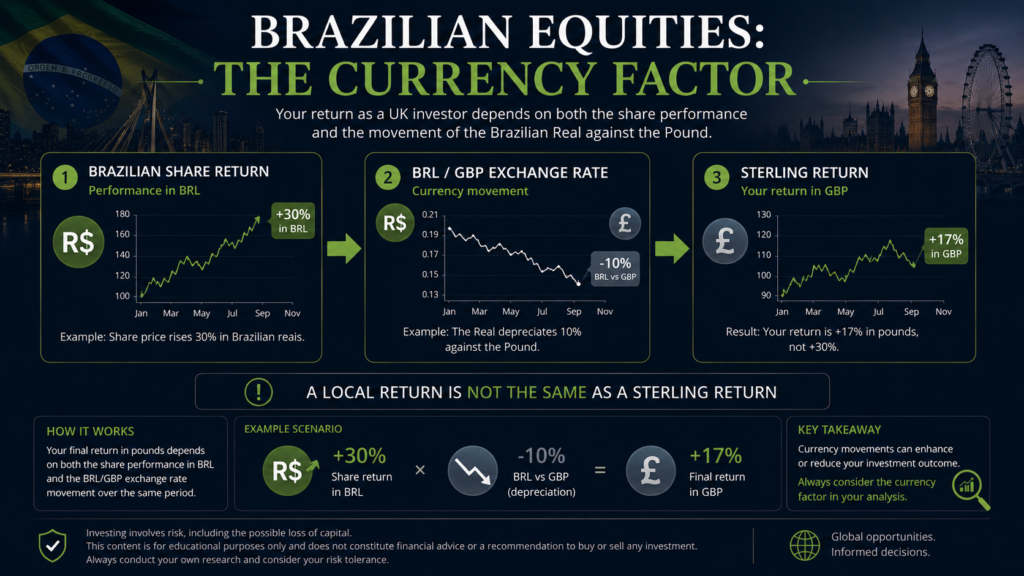
A Simple Example
Imagine an investor buys a Brazilian share.
During the year:
Share price: +15% in BRL
Brazilian real: -10% against GBP
The investor’s return in pounds would not be 15%.
The exact result depends on the sequence of the movements and transaction costs, but the simplified lesson is clear:
Local-market performance and investor-currency performance are not the same thing.
This is why currency should be part of the investment analysis from the beginning.
Brazilian Equities and Interest Rates
Interest rates have a particularly strong influence on Brazilian shares.
The benchmark Selic rate affects:
- borrowing costs;
- consumer credit;
- corporate financing;
- savings behaviour;
- fixed-income returns;
- company valuations.
When Brazilian interest rates are high, investors may find fixed-income products more attractive relative to equities.
High rates can also increase the cost of borrowing for companies and consumers.
This can put pressure on businesses that depend heavily on credit or future growth.
Conversely, falling interest rates can create a more supportive environment for some equity sectors.
That is why understanding Brazil’s monetary-policy cycle can be extremely useful when analysing Brazilian shares.
Why Valuation Matters
A good company isn’t necessarily a good investment at any price.
This principle applies equally to Brazilian equities.
Imagine two companies with similar businesses.
Company A trades at a much higher valuation than Company B.
If the market has already priced in extremely optimistic expectations for Company A, even strong business performance may not produce attractive investment returns.
Investors therefore commonly examine measures such as:
- price-to-earnings;
- price-to-book;
- enterprise value;
- free cash flow;
- dividend yield;
- return on equity;
- debt levels;
- earnings growth.
These metrics are useful starting points, but none should be used in isolation.
The appropriate valuation depends on the business, industry, growth prospects and risks.
Why Brazilian Valuations Can Look Different
Brazilian companies operate in a different economic environment from companies in developed markets.
Investors may therefore assign different valuation multiples.
Factors that can influence valuations include:
- interest rates;
- inflation;
- political risk;
- currency volatility;
- economic growth;
- commodity cycles;
- market liquidity;
- investor sentiment.
This can occasionally create situations where Brazilian companies appear inexpensive compared with international peers.
But a low valuation does not automatically mean an opportunity.
Sometimes an asset is cheap because investors correctly anticipate substantial risks.
The challenge is determining the difference between:
undervalued
and
cheap for a reason.
Brazilian Equities and Political Risk
Political developments can influence Brazilian markets.
Government decisions can affect:
- taxation;
- regulation;
- infrastructure;
- state-owned companies;
- energy policy;
- public spending;
- interest-rate expectations;
- fiscal credibility.
This does not mean every political event will significantly affect every company.
The impact depends heavily on the business.
A regulated utility may have a different exposure to government decisions from a privately owned consumer company.
Investors therefore need to examine company-specific political and regulatory exposure, rather than simply assigning one “Brazil risk” number to the entire market.
State-Owned Companies
Brazil has several large companies with government involvement or state ownership.
These can be economically significant and may offer exposure to strategically important sectors.
But state ownership can introduce an additional consideration:
commercial decisions may sometimes interact with public policy objectives.
For investors, this can create both opportunities and risks.
A company may benefit from its strategic importance.
At the same time, investors need to understand the governance structure and the potential influence of government shareholders.
Brazil’s Emerging-Market Status
Brazil is generally classified as an emerging market.
That classification matters because emerging-market equities can experience greater volatility than many developed-market investments.
They may also be affected more strongly by:
- global capital flows;
- changes in US interest rates;
- geopolitical events;
- commodity prices;
- currency movements;
- investor risk appetite.
During periods when global investors become more cautious, capital can move away from emerging markets.
Brazilian equities may therefore experience significant movements even when individual companies continue to perform reasonably well.
Are Brazilian Equities More Risky Than UK Equities?
It would be too simplistic to say that every Brazilian share is riskier than every UK share.
Risk depends on the specific company and investment.
However, UK investors should recognise that Brazilian equities can introduce additional sources of risk, including:
- currency risk;
- emerging-market risk;
- political risk;
- regulatory risk;
- commodity exposure;
- liquidity differences.
A large, established Brazilian company may have a very different risk profile from a small Brazilian company.
The correct approach is to analyse the individual investment.
How Can a UK Investor Gain Exposure?
There are several potential routes to Brazilian equities.
Direct Brazilian Shares
An investor may purchase shares listed on B3 through an appropriate investment structure.
This can provide direct exposure to individual companies.
However, access, custody, regulation and tax considerations need to be investigated.
Brazilian Equity Funds
Funds can provide exposure to a portfolio of Brazilian shares rather than requiring the investor to select individual companies.
This can reduce company-specific concentration.
But investors still need to understand:
- the fund’s strategy;
- fees;
- holdings;
- currency;
- domicile;
- liquidity;
- tax treatment.
ETFs
Exchange-traded funds can provide another route to Brazilian equity exposure.
Some track broad Brazilian indices, while others focus on particular strategies or sectors.
For a UK investor, an internationally accessible ETF can sometimes be operationally simpler than accessing individual Brazilian shares directly.
But availability varies between platforms and jurisdictions.
Internationally Listed Brazilian Companies
Some Brazilian companies have securities or listings accessible through international markets.
These can provide exposure to Brazilian businesses without necessarily requiring the investor to use the same infrastructure as a domestic Brazilian investor.
Again, the exact structure matters.
Direct Shares vs Funds: Which Is Better?
Neither is universally better.
Individual shares
Potential advantages:
- greater control;
- ability to select specific businesses;
- potentially more targeted exposure.
Potential disadvantages:
- greater company-specific risk;
- more research required;
- potentially greater concentration.
Funds and ETFs
Potential advantages:
- diversification;
- simpler portfolio construction;
- easier exposure to the overall market.
Potential disadvantages:
- management or platform fees;
- less control over individual holdings;
- index composition risk;
- possible tracking differences.
For someone new to Brazil, a diversified approach may be easier to understand than attempting to select individual companies immediately.
What About Brazilian Small-Cap Shares?
Brazil’s equity market isn’t limited to large companies.
Smaller listed businesses can offer exposure to:
- domestic growth;
- niche industries;
- emerging business models;
- faster-growing sectors.
But smaller companies can also have:
- lower liquidity;
- greater volatility;
- less predictable earnings;
- higher financing risk.
For international investors, these characteristics can become particularly important.
A small share that trades actively in Brazil may still be relatively difficult to access or exit through an international platform.
The Importance of Liquidity
Liquidity describes how easily an asset can be bought or sold without significantly affecting its price.
Large Brazilian companies with substantial trading volumes may offer relatively better liquidity.
Smaller companies may trade less frequently.
This matters because an investment thesis can be correct while the practical execution of the trade remains difficult.
For a UK investor, liquidity should therefore be evaluated at two levels:
How liquid is the Brazilian security?
and
How accessible is that security through my investment platform?
Taxation for UK Investors
Tax is another important consideration.
Brazilian shares can generate:
- dividends;
- capital gains;
- other forms of investment income.
The applicable tax treatment depends on the investor’s circumstances and the specific investment structure.
UK tax rules also apply to UK residents and can cover foreign income and gains.
HMRC provides guidance on foreign income and gains and how UK tax may apply.
Foreign tax treatment can also interact with the UK’s rules and applicable tax arrangements.
Therefore, investors should not assume that the tax treatment of a Brazilian share is identical to that of a UK share.
For significant investments, professional UK tax advice can be particularly valuable.
Brazilian Equities as Part of a Diversified Portfolio
The strongest argument for Brazilian equities may not be that they will outperform the UK.
It may be that they provide different exposure.
Consider a hypothetical portfolio concentrated in:
- UK banks;
- UK retailers;
- UK property;
- UK industrial companies.
Adding Brazilian companies could introduce exposure to:
- Latin American banking;
- Brazilian commodities;
- Brazilian energy;
- emerging-market consumption;
- different interest-rate conditions.
The portfolio would then be influenced by a wider range of economic factors.
That is the essence of international diversification.
But Diversification Does Not Mean “Buy Everything”
Owning international investments does not automatically create a better portfolio.
If you add Brazilian assets simply because they look attractive after a strong rally, you may be increasing risk rather than improving diversification.
The right questions are:
How much exposure do I already have?
What percentage of my portfolio is exposed to emerging markets?
How much currency risk am I comfortable with?
What happens if Brazil underperforms for several years?
Can I remain invested through significant volatility?
Portfolio construction matters just as much as asset selection.
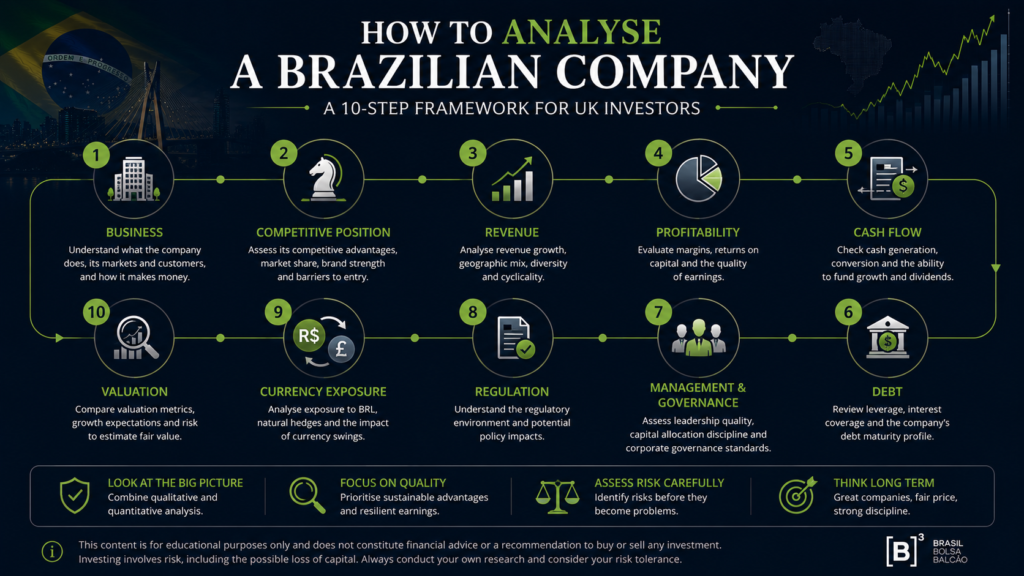
A Framework for Analysing a Brazilian Company
If you want to research an individual Brazilian company, consider following a structured process.
1. Understand the business
What does the company actually do?
2. Understand its competitive position
Why should customers choose it?
3. Analyse revenue
Where does its income come from?
4. Examine profitability
Are margins sustainable?
5. Examine cash flow
Does accounting profit translate into actual cash?
6. Check debt
How vulnerable is the company to high interest rates?
7. Analyse management and governance
Who controls the company?
8. Understand regulation
Is the business heavily influenced by government policy?
9. Consider currency exposure
Does the company earn in BRL, USD or other currencies?
10. Assess valuation
What expectations are already reflected in the share price?
This process can transform investing from speculation into analysis.
Brazilian Equities: Opportunity and Risk
Brazilian shares offer several potentially attractive characteristics:
Emerging-market exposure
Commodity exposure
Large domestic consumption
Potential dividend income
Different interest-rate dynamics
Potential valuation opportunities
But they also involve:
Currency volatility
Political risk
Interest-rate sensitivity
Commodity cycles
Emerging-market volatility
Liquidity considerations
Regulatory uncertainty
The two lists should always be considered together.
Don’t Buy Brazil — Understand Brazil
This distinction is important for the philosophy of international investing.
A country is not an investment.
A stock is an investment.
A bond is an investment.
A fund is an investment.
“Brazil” is simply the economic environment in which those investments operate.
Therefore, saying:
“I want exposure to Brazil.”
is only the beginning of the analysis.
The next questions should be:
“Exposure to what?”
“Through which asset?”
“At what valuation?”
“With which risks?”
“In which currency?”
These questions lead to much better investment decisions.
What Should a UK Investor Research Next?
If Brazilian equities interest you, a logical research sequence would be:
- Understand the Brazilian economy.
- Learn how the Selic rate affects companies.
- Study the main sectors of B3.
- Understand the Ibovespa.
- Compare Brazilian and UK valuations.
- Research individual companies.
- Investigate Brazilian equity funds and ETFs.
- Understand BRL/GBP currency exposure.
- Investigate UK and Brazilian tax considerations.
- Decide whether the potential exposure fits your overall portfolio.
The objective is not to rush towards a purchase.
It is to develop enough understanding to make a rational decision.
The Bigger Opportunity
For a UK investor, Brazilian equities can open the door to a financial world that is significantly different from the familiar UK market.
The opportunity lies not simply in potentially higher returns.
It lies in gaining access to different:
companies
industries
commodities
economic cycles
interest rates
currencies
growth drivers
That can make Brazilian equities a fascinating area for international portfolio research.
But the same differences that create opportunity can create significant volatility.
Final Thoughts
Brazilian equities deserve attention from investors who want to look beyond traditional developed markets.
The country has a large economy, substantial natural resources, a significant domestic market and a diverse listed-company ecosystem.
Its stock market provides exposure to sectors ranging from banking and consumer businesses to mining, energy, utilities and infrastructure.
For UK investors, the potential attraction goes beyond individual companies.
Brazil can introduce an entirely different set of economic drivers into a portfolio.
But international investing requires discipline.
A high dividend yield does not guarantee income.
A low valuation does not guarantee appreciation.
A high interest-rate environment does not guarantee a high sterling return.
And a strong Brazilian company does not eliminate currency or country risk.
The most useful mindset is therefore simple:
Don’t invest in Brazil because it looks different. Understand the differences, analyse the opportunities, measure the risks and then decide whether they deserve a place in your portfolio.
That is how Brazilian equities move from being an unfamiliar emerging market to becoming a properly understood component of the global investment landscape.
Important Note
This article is for educational and informational purposes only. It does not constitute personal investment, financial or tax advice and does not recommend any particular company, share, fund, ETF or investment strategy.
Investments can fall as well as rise in value, and investors may receive less than they originally invested. Brazilian equities can involve additional currency, political, regulatory, liquidity, interest-rate and emerging-market risks.
UK investors should verify current regulations, tax rules, investment access and product availability before making investment decisions and consider obtaining appropriate professional advice.
Primary sources and further reading
Relevant primary sources include B3, Brazil’s securities regulator CVM, Brazil’s Central Bank and HMRC, particularly for market structure, regulation, foreign investment and UK tax considerations.
RELATED POSTS
View all


How to Get Your Finances Organised from Scratch
August 13, 2026 | by imparsolucoes2002@gmail.com

Budgeting: The Tool That Can Change Your Relationship with Money
August 15, 2026 | by imparsolucoes2002@gmail.com

Brazilian Government Bonds: A Guide for UK Investors
August 15, 2026 | by imparsolucoes2002@gmail.com