


Brazilian Government Bonds: A Guide for UK Investors
August 15, 2026 | by imparsolucoes2002@gmail.com


Brazilian government bonds are one of the most important parts of the country’s fixed-income market. For UK investors, they can offer exposure to Brazil’s interest rates and currency — but the headline yield is only part of the story.
When international investors first discover the Brazilian financial market, one feature often stands out immediately:
interest rates can be significantly higher than those available in many developed markets.
This naturally raises an interesting question:
Could Brazilian government bonds offer an attractive opportunity for a UK investor?
The answer depends on much more than the interest rate displayed on the investment.
A UK investor must also consider the Brazilian real, inflation, interest-rate movements, taxation, access to the market and the risks associated with investing in an emerging economy.
This article explains how Brazilian government bonds work, the main types available, and what a UK investor should understand before considering them.
What Are Brazilian Government Bonds?
A government bond is essentially a loan made by an investor to a government.
The government raises money by issuing debt securities and, in return, promises to make payments according to the terms of the bond.
In Brazil, federal government bonds are issued by the Tesouro Nacional, Brazil’s National Treasury.
The official Brazilian investor portal describes government bonds as fixed-income securities issued by the Federal Government to raise funds for public financing. Investors are effectively lending money to the government in exchange for a return.
For Brazilian investors, these securities are generally regarded as having the lowest sovereign credit risk within the domestic Brazilian investment market.
However, this does not mean that they are risk-free for a UK investor.
There is a crucial distinction:
Brazilian government credit risk is not the same as sterling investment risk.
Even if the Brazilian government honours its obligation in Brazilian reais, the pound value of the investment can still fluctuate substantially.
What Is Tesouro Direto?
One of the best-known ways Brazilian individuals access federal government bonds is through Tesouro Direto.
It is a programme developed by Brazil’s National Treasury in partnership with B3 that allows individuals to buy and sell government securities electronically.
The programme provides access to several different types of Brazilian government securities.
The main categories include:
- Tesouro Selic
- Tesouro Prefixado
- Tesouro IPCA+
- Tesouro RendA+
- Tesouro Educa+
Not every product is designed for the same objective.
Some are primarily associated with interest-rate exposure.
Others are designed to provide protection against inflation or generate income for specific long-term objectives.
Understanding the difference is essential.
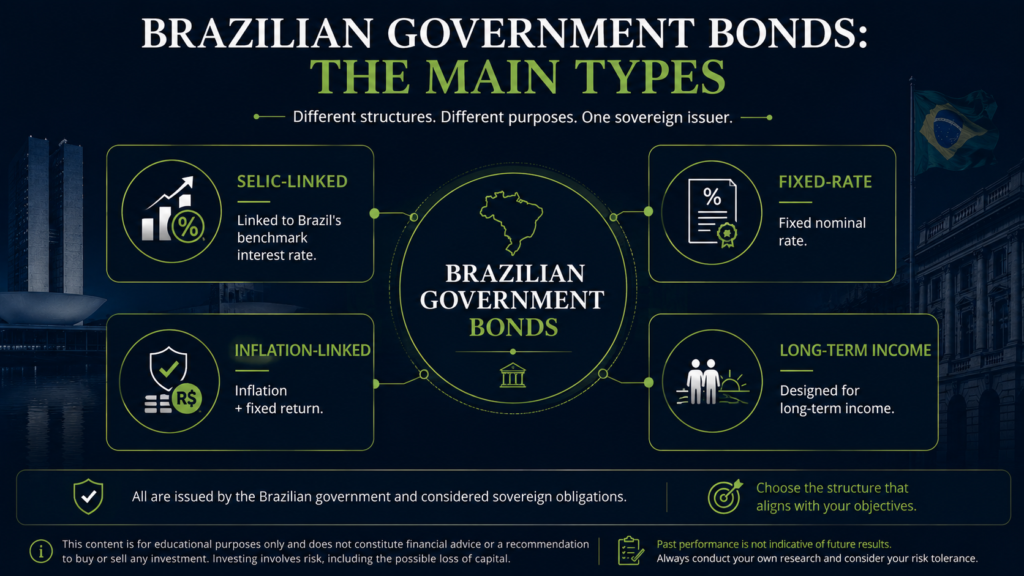
1. Tesouro Selic
The Tesouro Selic is linked to Brazil’s benchmark interest rate, the Selic.
It is generally considered one of the most straightforward Brazilian government bonds for investors seeking exposure to Brazilian interest rates.
The Brazilian government’s investor guidance describes Tesouro Selic as particularly suitable for shorter-term needs and notes that its price tends to experience relatively limited daily fluctuations compared with other government securities.
The basic idea is relatively simple:
Brazilian interest rates rise → the return environment for Selic-linked investments becomes more attractive.
Brazilian interest rates fall → the return environment becomes less attractive.
This makes Tesouro Selic particularly interesting when studying Brazil’s monetary-policy cycle.
However, a UK investor should not look at the Selic rate alone.
The investment is denominated in Brazilian reais.
If the real weakens significantly against sterling, the currency movement can reduce the return measured in pounds.
2. Tesouro Prefixado
Tesouro Prefixado is a fixed-rate government bond.
The interest rate is established when the investor purchases the security, assuming it is held according to the relevant terms.
The Brazilian Treasury describes it as a product where the investor knows the fixed rate applicable at the time of purchase.
At first glance, this may appear straightforward.
Suppose a bond is purchased with a fixed nominal rate.
If held until maturity, the investor knows the contractual return structure.
But there is an important complication:
the market value can change before maturity.
If market interest rates rise after you buy a fixed-rate bond, an existing bond paying a lower rate may become less attractive to other investors.
Its market price can therefore fall.
Conversely, if market rates decline, an existing bond with a relatively attractive fixed rate can become more valuable.
This is known as mark-to-market.
What Is Mark-to-Market?
This concept is particularly important for anyone considering Brazilian government bonds.
Imagine you buy a fixed-rate bond today.
A few months later, Brazilian interest rates rise substantially.
New bonds are now being issued with higher yields.
Your existing bond has a lower rate.
If you wanted to sell your bond before maturity, you might have to accept a lower market price to compensate the buyer.
Therefore:
A bond can be held by the investor until maturity and still have a changing market value along the way.
This distinction is critical.
The fact that a government bond has a defined maturity does not mean its market price remains constant before that date.
The Brazilian Treasury specifically highlights the impact of market pricing when fixed-rate securities are sold before maturity.
3. Tesouro IPCA+
Another important category is Tesouro IPCA+.
Instead of providing only a nominal fixed rate, these securities are linked to Brazil’s official inflation index, the IPCA, plus an additional interest component.
This creates a structure broadly expressed as:
Inflation + fixed return
The attraction is obvious.
If inflation rises, the inflation-linked component adjusts accordingly.
The Brazilian Treasury identifies Tesouro IPCA+ as a product designed to provide returns above inflation.
For investors concerned about maintaining purchasing power over the long term, inflation-linked bonds can therefore be particularly relevant.
But there is an important distinction for UK investors:
IPCA protects against Brazilian inflation, not UK inflation.
If your spending, wealth and financial objectives are primarily in pounds, Brazilian inflation protection is not equivalent to protection against inflation in the United Kingdom.
4. Tesouro RendA+
Brazil also offers Tesouro RendA+, designed around long-term retirement income.
Its structure differs from conventional government bonds because it is designed to provide inflation-linked income over a defined period after the investment’s accumulation phase.
The product is therefore particularly relevant when discussing Brazilian retirement planning.
For a UK investor, however, the question becomes more complicated.
The investor needs to consider:
- Brazilian inflation;
- Brazilian interest rates;
- BRL/GBP exchange rates;
- the investment horizon;
- UK tax treatment;
- whether the income structure actually matches their financial objectives.
A product designed primarily for Brazilian retirement needs should not automatically be assumed to be appropriate for a UK retirement strategy.
5. Tesouro Educa+
Another specialised government-security category is Tesouro Educa+, designed around education-related financial planning.
The current Tesouro Direto framework includes both Tesouro RendA+ and Tesouro Educa+ among its government securities.
These products demonstrate an important characteristic of the Brazilian government-bond market:
government securities are not simply one generic investment.
Different bonds can be structured around different financial objectives.
For a UK investor, however, the usefulness of each product depends on whether its structure fits the investor’s circumstances.
Why Are Brazilian Government Bonds Interesting?
The primary attraction for many investors is the Brazilian interest-rate environment.
Brazil has historically operated with relatively high nominal interest rates compared with many developed economies.
This can make Brazilian fixed income appear particularly attractive when viewed from abroad.
But the correct question is not:
“How high is the Brazilian interest rate?”
It is:
“What return could I realistically receive in pounds after considering interest rates, inflation, currency movements, taxes and costs?”
That is a much more useful question.
The Currency Problem: BRL vs GBP
This is arguably the most important issue for UK investors.
Brazilian government bonds are generally denominated in Brazilian reais.
Your financial life may be denominated primarily in pounds.
Therefore, your investment has two layers of performance:
Layer 1 — The Brazilian bond
How much did the bond earn in BRL?
Layer 2 — The exchange rate
How did the Brazilian real perform against sterling?
These two factors combine to determine your approximate return in pounds.

A Simplified Example
Imagine that:
- you invest £10,000;
- the Brazilian investment generates a strong return in BRL;
- but the Brazilian real falls significantly against sterling.
The investment may look excellent when viewed in Brazilian currency.
Yet the sterling return could be much lower.
The reverse is also true.
If the Brazilian real strengthens against the pound, currency movements can increase the sterling value of the investment.
This is why international investing is never simply about the local asset’s return.
Brazilian Interest Rates and the Selic
To understand Brazilian government bonds, you need to understand the Selic rate.
The Selic is Brazil’s benchmark interest rate and is determined by the country’s monetary-policy process.
It influences borrowing costs, savings products, fixed-income investments and broader financial-market valuations.
When the Selic is high, Brazilian fixed-income products can become particularly attractive to investors seeking income.
When the Selic falls, the environment changes.
Existing fixed-rate bonds can potentially benefit from falling market yields because their previously agreed rates become relatively more attractive.
This is one reason interest-rate expectations matter so much when analysing Brazilian government bonds.
High Interest Rates Do Not Mean Guaranteed High Returns
This deserves emphasis.
A high nominal interest rate may look extremely attractive to a UK investor.
But the final return depends on several variables.
A simplified framework is:
Nominal return
minus
inflation
minus
taxes and costs
plus/minus
currency movement
equals
investor’s effective outcome
This isn’t a precise investment-return formula, but it illustrates the principle.
The headline interest rate is only one part of the equation.
Brazilian Government Bonds vs UK Gilts
A natural comparison for a UK investor is with UK government bonds, or gilts.
At first glance, the comparison may appear simple:
Brazilian government bond → higher yield
UK gilt → lower yield
But that would be an incomplete analysis.
The investments differ in several important ways.
| Factor | Brazilian Government Bonds | UK Gilts |
|---|---|---|
| Issuer | Brazilian Federal Government | UK Government |
| Currency | Brazilian real | Pound sterling |
| Market classification | Emerging market | Developed market |
| Currency risk for UK investor | Significant | Much lower |
| Interest-rate environment | Different monetary cycle | Different monetary cycle |
| Country risk | Brazil-specific | UK-specific |
| Inflation exposure | Brazilian inflation | UK inflation |
| Potential volatility | Can be higher | Generally lower for a UK-based investor |
The Brazilian bond may offer a higher nominal yield.
But the UK gilt may carry considerably less currency and emerging-market exposure for someone whose wealth is primarily in pounds.
So the question is not:
“Which pays more?”
It is:
“Which risk-return profile is more appropriate for my portfolio?”
Can UK Investors Buy Brazilian Government Bonds?
This is where the distinction between Brazilian residents and non-resident investors becomes important.
Foreign investors can access Brazilian financial and capital markets, but the process is subject to regulatory and operational requirements.
Brazilian authorities provide specific rules for non-resident investors, including requirements relating to registration, representation and market access.
The National Treasury also publishes a specific Non-Resident Investors Handout covering Brazil’s federal public debt market and the process for foreign investors.
This means a UK investor should not assume that buying Brazilian government bonds works exactly like purchasing a UK gilt through a normal UK investment account.
Access may depend on:
- the investor’s status;
- the broker or financial institution;
- custody arrangements;
- registration;
- Brazilian regulatory requirements;
- the specific security;
- tax considerations.
The practical route therefore needs to be investigated before investing.
What About Tesouro Direto for UK Investors?
Tesouro Direto is primarily designed as an accessible platform for individual investors in Brazil.
The Brazilian Treasury describes direct access through financial institutions and the programme’s online infrastructure.
A UK-based investor should not assume that being able to access a website means being eligible to purchase securities through the programme as a non-resident.
Non-resident investment has its own regulatory framework.
For this reason, an investor based in the UK should investigate the appropriate route through a regulated financial institution rather than treating Tesouro Direto as equivalent to a UK retail investment platform.
What Are the Main Risks?
Brazilian government bonds are sovereign debt, but several risks remain relevant.
1. Currency risk
The Brazilian real can appreciate or depreciate substantially against sterling.
2. Interest-rate risk
Bond prices can change as Brazilian market interest rates change.
3. Inflation risk
Inflation can affect the real purchasing power of returns.
4. Sovereign risk
Government debt is not completely free of credit or fiscal risk.
5. Liquidity risk
Some securities and market conditions can make exiting an investment less attractive.
6. Political and fiscal risk
Government policy, public finances and political developments can influence bond markets.
7. Tax risk
The tax treatment of Brazilian investments can differ depending on the investor’s status and circumstances.
For UK investors, Brazilian investment taxation and UK tax reporting must both be considered.
Tax: Brazil and the UK
Tax is one of the areas where international investing can become particularly complicated.
The Brazilian tax treatment of government securities depends on factors including the investor’s residency and the nature of the investment.
Brazil also has specific rules concerning non-resident investors.
On the UK side, UK residents may have reporting and tax obligations concerning foreign income and gains.
HMRC states that UK residents generally need to consider foreign income and capital gains when completing their tax affairs, subject to the applicable rules and exemptions.
Foreign tax paid may, in certain circumstances, qualify for Foreign Tax Credit Relief, subject to the relevant rules.
This is an area where individual circumstances matter considerably.
Your tax position can depend on:
- UK residency;
- the investment structure;
- the type of income;
- capital gains;
- where the investment is held;
- foreign taxes paid;
- applicable reliefs;
- your wider tax position.
Do not calculate the attractiveness of a Brazilian bond using the headline yield alone.
Tax should be part of the analysis from the beginning.
Which Brazilian Government Bond Is Best?
There is no universally “best” Brazilian government bond.
Different securities serve different purposes.
Tesouro Selic
Potentially relevant for investors seeking exposure to Brazil’s short-term interest-rate environment and relatively lower price volatility.
Tesouro Prefixado
Potentially relevant for investors seeking a fixed nominal rate and willing to accept interest-rate and market-price risk.
Tesouro IPCA+
Potentially relevant for investors seeking Brazilian inflation-linked returns over longer periods.
Tesouro RendA+
Designed around long-term income and retirement planning.
Tesouro Educa+
Designed around education-related financial planning.
The appropriate choice depends on the objective.
And for a UK investor, there is an additional question:
Does the objective itself make sense when the investment is denominated in Brazilian reais?
What If the Pound Strengthens?
This is a useful scenario to consider.
Suppose you buy a Brazilian bond because you expect the Brazilian interest rate to generate an attractive return.
Over the same period, sterling strengthens considerably against the real.
When you convert your investment back into pounds, the currency movement could significantly reduce the sterling return.
This is not a flaw in the bond.
It is simply the consequence of investing internationally.
The same principle applies in reverse.
If sterling weakens against the Brazilian real, the currency movement could increase the sterling value of your Brazilian investment.
Therefore, currency is part of the investment thesis.
Should UK Investors Hedge the Currency?
Currency hedging is a separate strategic decision.
A UK investor may consider whether they want:
unhedged exposure to BRL
or
some form of currency hedging
Each approach has advantages, disadvantages and costs.
Unhedged exposure means that currency movements directly affect the sterling value of the investment.
Hedging can reduce some currency fluctuations but may introduce additional costs and complexities.
There is no universally correct choice.
The decision depends on:
- investment horizon;
- objectives;
- risk tolerance;
- expected currency exposure;
- cost of hedging;
- portfolio structure.
For a beginner, the key lesson is simply:
Know whether your Brazilian investment is exposed to the BRL/GBP exchange rate.
A Brazilian Bond Is Not the Same as a UK Savings Account
This distinction is important.
Someone might see a high Brazilian interest rate and assume the investment is comparable to placing cash into a UK savings account.
It isn’t.
A Brazilian government bond can involve:
- market-price movements;
- currency fluctuations;
- inflation;
- emerging-market risk;
- taxation;
- different liquidity characteristics.
Therefore, Brazilian government bonds should be analysed as investment securities, not simply as high-interest savings products.
When Could Brazilian Government Bonds Be Interesting?
There are several situations in which an investor might want to research them further.
Exposure to Brazilian interest rates
An investor may want exposure to Brazil’s monetary cycle.
Emerging-market diversification
The bonds can provide exposure to a major emerging economy.
Potential income
Brazil’s interest-rate environment can create attractive nominal yields.
Inflation-linked exposure
Certain securities provide exposure to Brazilian inflation plus a real component.
Portfolio diversification
Brazilian fixed income can behave differently from UK government bonds.
But these potential advantages must always be weighed against currency and country-specific risks.
When Might They Not Make Sense?
Brazilian government bonds may be less suitable when:
- the investor cannot tolerate currency volatility;
- the investment horizon is too short;
- the investor needs certainty in GBP;
- the investor does not understand mark-to-market risk;
- the tax and administrative complexity outweigh the potential benefit;
- the investment would create excessive concentration in Brazil.
The best investment is not necessarily the one with the highest advertised yield.
It is the one whose risks you understand and can accept.
A Better Way to Compare Returns
Imagine a UK investor comparing:
UK government bond
with
Brazilian government bond
Instead of comparing only the advertised interest rates, build a broader framework:
Step 1 — Compare nominal yields
How much does each security pay?
Step 2 — Consider inflation
What happens to purchasing power?
Step 3 — Consider currency
What happens to BRL against GBP?
Step 4 — Consider taxation
What remains after relevant taxes?
Step 5 — Consider volatility
Could the market value change significantly before maturity?
Step 6 — Consider liquidity
How easily can you exit?
Step 7 — Consider portfolio role
What does the investment add to your existing portfolio?
Only after answering these questions does the yield comparison become meaningful.
The Bigger Picture
Brazilian government bonds are particularly interesting because they sit at the intersection of several major investment themes:
Emerging markets
High interest rates
Inflation
Currency
Sovereign debt
International diversification
This makes them a useful entry point for understanding Brazilian assets more broadly.
But the objective should not be to chase high yields.
It should be to understand why those yields exist.
Final Thoughts: Look Beyond the Yield
Brazilian government bonds can be an intriguing asset class for UK investors.
They provide access to one of the world’s largest emerging economies and can offer exposure to a very different interest-rate environment from the UK.
But the headline yield is only the beginning.
A UK investor must also consider:
BRL vs GBP
Brazilian inflation
interest-rate movements
mark-to-market risk
taxation
regulatory access
liquidity
portfolio diversification
The key lesson is simple:
A high local-currency return does not automatically become a high sterling return.
Brazilian government bonds therefore deserve to be analysed not as a shortcut to higher returns, but as a distinct component of the international investment landscape.
And that is the real purpose of exploring Brazilian assets:
not to promise better returns, but to discover opportunities that become visible when you look beyond your usual financial horizon.
Important Note
This article is provided for educational and informational purposes only. It does not constitute personal investment, financial or tax advice and does not recommend any particular government bond or investment strategy.
Investments can fall as well as rise in value, and investors may receive less than they originally invested. Brazilian government bonds can involve currency, interest-rate, liquidity, inflation, sovereign and emerging-market risks.
Tax rules, regulations and access requirements can change. UK investors should verify the current rules and consider obtaining appropriate professional advice before investing.
Primary sources and further reading
The information in this article has been grounded primarily in official Brazilian and UK sources, including Brazil’s National Treasury, the Brazilian investor portal, CVM and HMRC.
Brazilian National Treasury — Tesouro Direto
Brazilian Government — Public Bonds
Brazilian Government — Non-Resident Investors
HMRC — Foreign Income and Gains
RELATED POSTS
View all


Budgeting: The Tool That Can Change Your Relationship with Money
August 15, 2026 | by imparsolucoes2002@gmail.com

How to Get Your Finances Organised from Scratch
August 13, 2026 | by imparsolucoes2002@gmail.com

Money: How to Get More from What You Already Earn
August 15, 2026 | by imparsolucoes2002@gmail.com